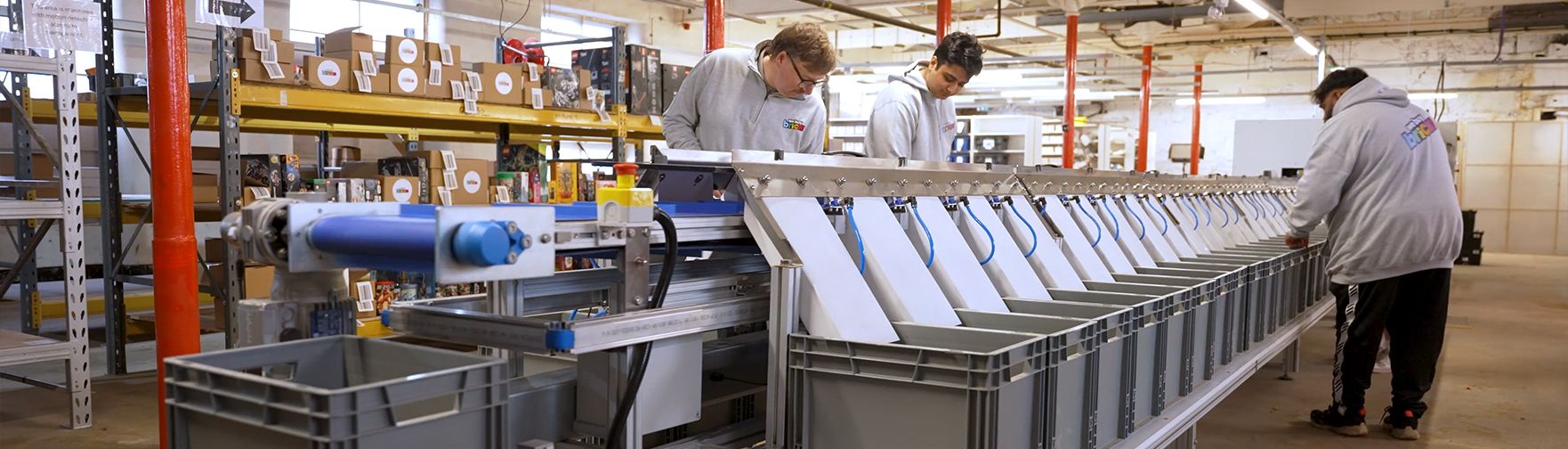
What happens when you combine LEGO® bricks, AI and an old Lancashire mill? Recently, WeBuyBricks appeared on BBC 5 Live Drive, where our Head of Projects, Brad Hacking, spoke to Chris Warburton and Claire McDonnell about the technology behind our Brick-o-Matic and how it is helping us sort pre-loved LEGO® bricks.
The interview gave listeners a look behind the scenes at how the machine takes a mixture of LEGO® pieces and identifies which sets they belong to. What could take a person hours to do by hand can now be handled by the Brick-o-Matic at a much larger scale.
Mixed LEGO® pieces are loaded into a hopper, where the Brick-o-Matic lines them up so a series of cameras can examine each piece. The machine uses AI to identify individual LEGO® pieces and determine which set they belong to. It can also identify scratches and broken pieces, removing them from the sorting process.
Once a piece has been identified, jets of air direct it into the appropriate chute, ready to be sorted into sets or bundles.
The Brick-o-Matic can currently identify more than 55,000 different LEGO® pieces, and the team is continuing to expand its capabilities.
During the BBC 5 Live interview, Brad explained that LEGO® bricks has more than 80,000 different pieces and around 19,000 sets. The Brick-o-Matic can currently sort well over 85% of LEGO® sets. The machine is also designed to handle large volumes of pieces. It currently processes around two pieces every second, which means it can sort more than 100,000 pieces a day.
For anyone who has ever tipped out a box of mixed LEGO® pieces and spent ages looking for one particular piece, the difference this can make is easy to imagine.
One of the main jobs of the Brick-o-Matic is helping WeBuyBricks find complete sets hidden within collections of mixed LEGO® pieces. Once the pieces have been sorted, they can be used to recreate complete sets or create bundles based on things such as colour or piece type. These can then be made available to other LEGO® fans.
By making the sorting process more efficient, WeBuyBricks aims to sell pre-loved sets for around 40–60% less than buying new.
There is something particularly fitting about seeing this kind of technology being developed inside an old Lancashire mill.
The Brick-o-Matic combines cameras, software and AI with specialist machinery to recognise and sort LEGO® pieces. The machines are British-built, and the technology is patented in the UK. It is a very modern solution to a very familiar problem: what do you do with a large box of mixed LEGO® bricks?
The BBC 5 Live interview also gave Brad the chance to explain where the name Brick-o-Matic came from, with a nod to Wallace and Gromit and Willy Wonka.
UK Five Live Drive with Claire McDonnell and Chris Warburton (14/09/2026)
Chris Warburton: So many many many of us will have had the misfortune of having to sort through hundreds of pieces of disassembled LEGO at some point in our lives. The brand generated nine billion pounds last year. Some sets cost a fair old bit - upwards of 500 quid – and the secondary market can be even more expensive. So, what should you do with all your old leftover LEGO?
Well one Lancashire company have unveiled an AI-powered sorting machine that they're calling the Brick-o-Matic. It can sort tons of mixed-up bricks into complete LEGO sets ready for new owners to build. It's amazing!
Let's speak to Brad Hacking, Head Of Projects at WeBuyBricks the company behind the machine. Hi Brad!
Brad Hacking: Hi Chris, Hi Claire!
Chris Warburton: I've watched a video of this; it's incredible work, I have to say. Talk us through how the machine does it.
Brad Hacking: Well first thanks for inviting me to speak with you. We're really happy to tell your listeners more about our new LEGO set sorting machine - as you said what we call the Brick-o-Matic. In essence we built the Brick-o-Matic for one simple reason; to make LEGO more affordable. As all your listeners know, new LEGO sets can be expensive, so we wanted to try and to find a way of processing and sorting used LEGO much more efficiently - essentially that means we can then sell those sets for 40 to 60 percent less than new.
Chris Warburton: It's a great idea. I love it. It's environmentally sound etc, but how does it actually work in practice? You get a whole load of mixed up LEGO, you put it on the conveyor belt and then what happens?
Brad Hacking: Exactly! It's a really clever piece of kit; we put a random mixture of mixed LEGO parts and pieces into a hopper in one end then the machine does a lot of processing. It lines those bricks up one at a time so a series of cameras can see each one. Then the really clever bit comes where it looks at each brick and it knows exactly which set that brick belongs to. It can even spot scratches and broken pieces and it takes them out as well. Once we decide what it wants to sort, a jet of air blasts those pieces into a shoot, ready to be sold again!
Chris Warburton: It's not just breaking it down into the same shape or the same color or whatever? It's able to say, almost instantaneously, that comes from this particular set of - I don't know – Harry Potter or whatever. It's that sophisticated, is it?
Brad Hacking: Exactly! We've trained the machine, or put the information into its “brain”; we're able to identify over 55,000 pieces. There's actually just over 80,000 so we're getting there. Out of the 19,000 sets that LEGO make, we can sort well over 85% of them.
Chris Warburton: Amazing! That really is! So how many pieces are you generally getting through a day?
Brad Hacking: The machine runs really quickly, so we're currently looking at two pieces every second, which means that each day we sort over a hundred thousand pieces.
Chris Warburton: It really is incredible!
Brad Hacking: It's certainly faster than trying to sort them yourself! If you try and sort some LEGO pieces it can take you it takes 10 minutes to find one piece if you have them laid out on the table.
Chris Warburton: And how are you selling it on then? Can people just go to your website and, all right it might not be in the box necessarily, but you've got the bag saying this is this particular set. Is that how it is?
Brad Hacking: You're right, and on our app and website you can sell us LEGO too. So people sell us LEGO as a mixture of just random bricks or people can sell us sets of LEGO. Within that random LEGO that we buy, we expect that there are sets within it. We can then sort for those sets and we also sort for bundles; whether it's a certain color or a type of piece. Then on the other part of our website you can then go and buy those sets.
Chris Warburton: What I really like is that this is modern technology. As modern as you could sort of get with AI. But it's being done in an old mill in Lancashire! It's new meeting old. It's a beautiful thing!
Brad Hacking: Yeah and we're really proud it's in Lancashire. The machines are British built. It's patented in the UK and we believe it's the first commercially viable LEGO bricks sorting machine here.
Chris Warburton: And the “Brick-o-Matic” is a sort of hat-tip to Wallace and Gromit is it?
Brad Hacking: Yes of course! A bit of Wallace and Gromit, Willie Wonka, all of that!
Chris Warburton: Yeah why not! You're doing a great thing Brad. Lovely talking to you. Thank you very much indeed!
The Brick-o-Matic is WeBuyBricks AI-powered LEGO® sorting machine. It uses cameras, software and AI to identify individual LEGO® pieces and determine which sets they belong to. It can also sort LEGO® pieces in other ways, such as by colour, rather than just sorting them into sets.
The Brick-o-Matic can currently identify more than 55,000 different LEGO® pieces, with the team continuing to expand its database and capabilities.
The machine currently processes around two pieces every second, allowing it to sort more than 100,000 LEGO® pieces a day.
Yes. The machine can identify scratches and broken pieces and remove them from the sorting process.
Sorted pieces can be used to recreate complete LEGO® sets or create bundles based on factors such as colour or piece type. These can then be sold as pre-loved LEGO® sets and bricks.
Whether you have a complete or incomplete set, or a box full of loose and mixed LEGO® pieces, you can sell your LEGO® sets and bricks to WeBuyBricks through our website or app.
Give your unwanted LEGO® bricks a new purpose while making some extra money.
Would you like to continue the conversation? Share this post!